Can a Cobot Really Pay For Itself?
Yes—and often faster than you think. Cobots are one of the most cost-effective forms of automation available today, especially for small and mid-sized manufacturers. This page shows you how to evaluate ROI, compare costs, and justify your investment with confidence.
 Key ROI Factors:
Cobots can fully replace or assist with hard-to-fill roles, reducing labor spend and reliance on temporary staff.
With faster cycle times and no breaks, cobots can boost output per shift.
Cobots maintain consistency, leading to fewer defects and lower scrap costs.
Cobots maintain consistency, leading to fewer defects and lower scrap costs.
Fewer repetitive motion injuries = fewer workers’ comp claims and less downtime.
No cages, no complex programming—just plug in, teach, and run.
Key ROI Factors:
Cobots can fully replace or assist with hard-to-fill roles, reducing labor spend and reliance on temporary staff.
With faster cycle times and no breaks, cobots can boost output per shift.
Cobots maintain consistency, leading to fewer defects and lower scrap costs.
Cobots maintain consistency, leading to fewer defects and lower scrap costs.
Fewer repetitive motion injuries = fewer workers’ comp claims and less downtime.
No cages, no complex programming—just plug in, teach, and run.
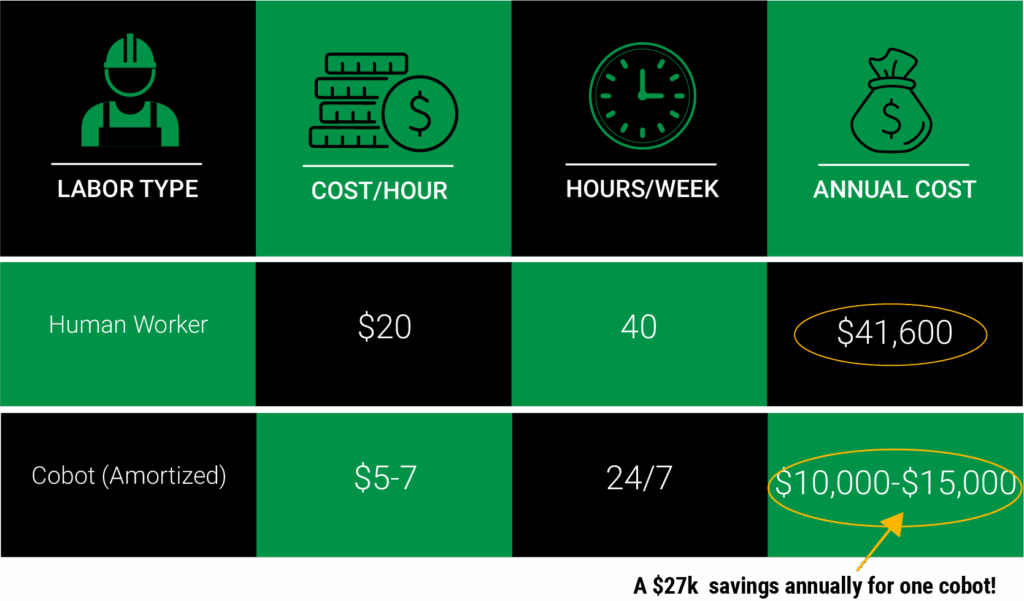
Cobot Vs. Human Labor Costs
Cobots don’t call in sick, require insurance, or quit.

We crunched the numbers and realized our cobot would break even in 7 months.
We ended up deploying two more within the year.
– Maintenance Manager, Metal Fabrication Plant
Is a Cobot Worth it For You?
You’re a good candidate if:
• You’re paying $18–30/hr for repetitive labor
• You struggle with staffing or high turnover
• You have tasks with consistent cycles or routines
• You want automation but not complexity