
AMR's & AGV's for Manufacturing

  • Home
  • AMR’s & AGV’s

Automate Movement. Reduce Risk. Free Up Labor.

What Are AMRs and AGVs?

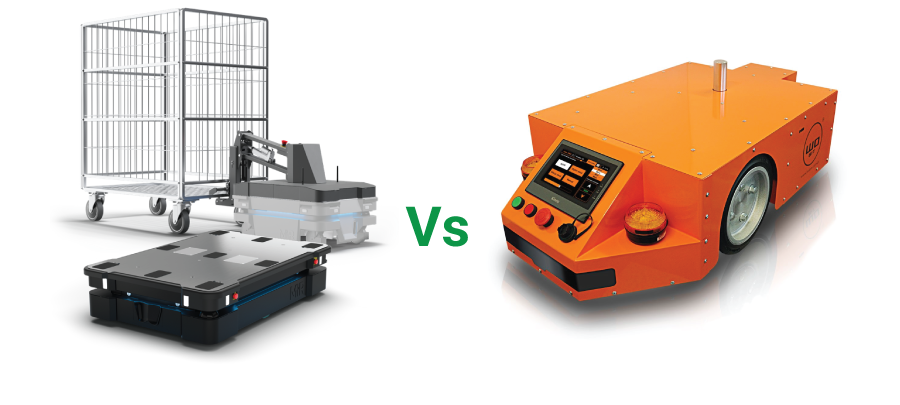
Both Autonomous Mobile Robots (AMRs) and Automated Guided Vehicles (AGVs) are used to move materials in manufacturing and warehouse environments—but they do it in different ways.

• AGVs follow fixed paths like magnetic strips or wires.
• AMRs use built-in sensors and maps to navigate dynamically around obstacles and people.

Both technologies eliminate the need for forklifts and carts, reducing congestion and improving safety.

Industries Benefiting from AMR’s & AGV’s

• Line-side material delivery
• Finished goods transport to packaging or warehouse
• Empty bin or pallet return
• Staging replenishment
• Work-in-progress (WIP) movement
• Supply room to production area transfers

AMR

Why Automate Internal Logistics?

Manual material movement can create hidden inefficiencies and safety risks.
By automating these tasks with AMRs and AGVs, manufacturers can:

• Streamline internal transport across shifts and zones
• Improve process control with intelligent routing and task scheduling
• Enhance safety by reducing human traffic in busy aisles
• Cut labor costs tied to transport, replenishment, and returns
• Increase uptime by reducing wait times between workstations

AMR and AGV

Automated Mobile Robots

Navigation: Dynamic, map-based
Flexibility: High – adapts to environment
Set-Up Costs: Lower infrastructure needs
Use Cases: Just-in-time transport, kits

Auto Guided Vehicles

Navigation: Fixed path (tracks or wires)
Flexibility: Low – route-dependent
Set-Up Costs: Requires physical changes
Use Cases: Repetitive, fixed-route tasks

collaborative robots-industry

Example Use Case:
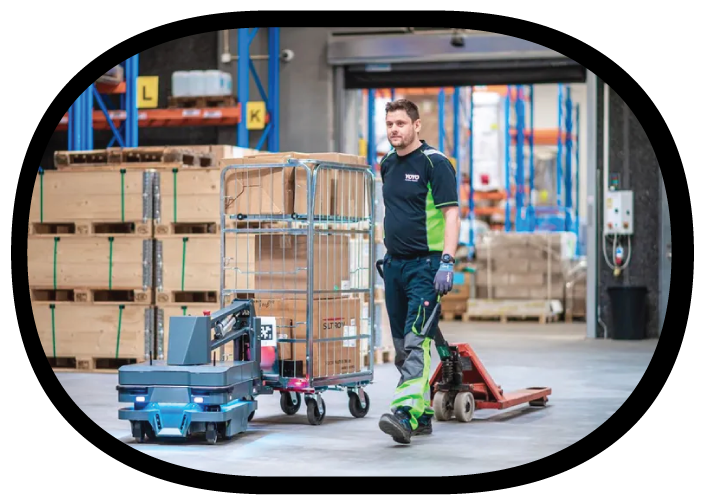
Autonomous Mobile Robot (AMR) in a Warehouse Setting


In a modern e-commerce fulfillment center, an AMR is used to transport inventory bins between storage areas and packing stations. When a customer places an order, the warehouse management system sends a task to the AMR, which autonomously navigates the warehouse floor using onboard sensors and mapping software to avoid obstacles and human workers. The AMR retrieves the bin with the ordered items and delivers it to a human packer, who completes the order for shipping. This automation reduces manual labor, increases efficiency, minimizes picking errors, and allows staff to focus on higher-value tasks.

Other Use Cases:

• Line-side material delivery
• Finished goods transport to packaging or warehouse
• Empty bin or pallet return
• Staging replenishment
• Work-in-progress (WIP) movement
• Supply room to production area transfers

mir in warehouse

Take the First Step Toward Logistics

Let us help you determine whether AMRs, AGVs, or a hybrid approach is right for your facility.

An Easy to Understand Guide

A book that makes sense

Try the Robot ROI Calculator

Compare your labor costs with cobots in minutes

Take The Plant Readiness Quiz